
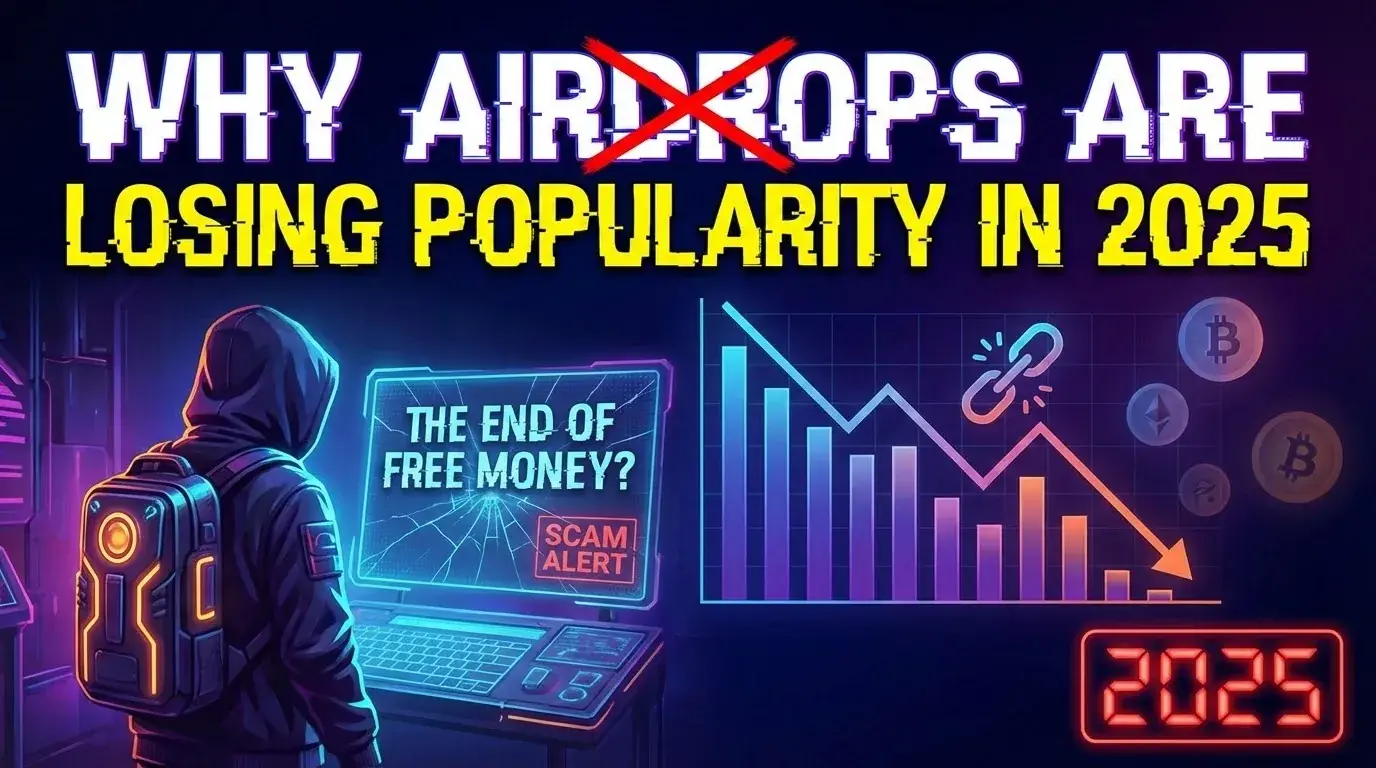
In 2025, the simple airdrop-farming playbook was nowhere near as dependable as it had appeared in parts of 2024. A few onchain transactions no longer offered a realistic expectation of hundreds or thousands of dollars in tokens. This article presents the author’s thesis for why that model lost its edge.
2026 update: Airdrops did not disappear. DeFiLlama’s State of DeFi 2025 described them as a primary token-distribution and early-user-acquisition mechanism, but found that broad recipient counts did not necessarily produce broad long-term ownership. The design shifted toward points, anti-Sybil screening and rewards tied to measurable economic contribution. Academic studies of Hop Protocol and LayerZero and six large-scale airdrops also document farming and post-distribution selling. The more accurate verdict is that undifferentiated “click tasks, get free money” campaigns weakened—not that every airdrop became useless.
Reader note: This is analysis, not a universal rule or a promise about any token. Outcomes depend on distribution design, product quality, market conditions and how retention is measured.
1. Airdrops Attract Farmers, Not Loyal Users
The core promise of airdrops was to put tokens in the hands of real users. In practice, poorly designed campaigns can disproportionately reward farmers—automated accounts and Sybil attackers who game eligibility criteria for profit.
- Farmers complete repetitive tasks (like testnet interactions or app clicks) using bots or multiple wallets.
- Once tokens are distributed, they sell immediately, flooding the market and crashing prices.
- These participants rarely engage with the protocol long-term. They’re not builders, not believers—just opportunists.
This creates a parasitic dynamic. The community looks active on paper, but it’s hollow. Metrics like TVL, transaction count, or user growth get inflated by non-organic activity, misleading investors and teams alike. In reality, farmed data says nothing about product health or future adoption.
2. Zero Retention: Tokens Don’t Create Sticky Users
If airdrops were meant to onboard loyal users, the data tells a different story.
- Churn can be extreme. Onchain studies of major distributions have found substantial selling by airdrop recipients, although the rate varies by project and methodology.
- Many broad, gamified airdrops have struggled to demonstrate sustained usage attributable to the distribution itself.
- Retentive, high-value users almost never come through airdrop channels.
Compare the total value of tokens distributed via airdrops over the years to the actual revenue generated by top protocols. The gap is staggering. If this were traditional marketing spend, the ROI would be considered catastrophic. Billions in token value given away—yet little to no lasting impact on user behavior or protocol revenue.
The author’s conclusion is that token giveaways alone do not reliably convert free users into engaged ones. Without a useful product and careful design, the distribution can become a liquidity event for sellers rather than a durable growth engine.
3. Airdrops Are Poorly Spent Marketing
Airdrops were once seen as a low-cost way to gain attention. But attention isn’t enough—it has to be the right kind.
- Most airdrops optimize for easily measurable but meaningless actions (e.g., “touch every button in the app”).
- This follows Goodhart’s Law: when a measure becomes a target, it ceases to be a good measure.
- Farmers optimize the system perfectly—then leave.
In today’s market, long-term value (LTV) matters more than customer acquisition cost (CAC). Projects are judged on revenue, retention, and economic sustainability—not vanity metrics. Handing out tokens to transient users doesn’t move the needle on any of these.
Even worse, airdrops dilute early supporters. Loyal holders and team members see their ownership eroded to reward people who contribute nothing and exit immediately.
4. Better Alternatives Exist: ICOs, Linear Rewards, and Revenue Sharing
If airdrops fail to put tokens in the right hands, what’s the alternative?
ICOs: Sell to Committed Buyers
- Direct token sales (including modern ICO or launchpad structures) let projects raise capital from buyers, but payment does not guarantee long-term alignment.
- Buyers pay real money, signaling conviction.
- Sales can include lockups, timeouts for flippers, or allocation rules to filter speculators.
- Oversubscribed sales give leverage to the project—rewarding good behavior, not gaming.
As one view puts it: If users are just going to sell, why not skip the middleman and sell the tokens yourself?
Linear Airdrops & Performance Rewards
Not all token distributions are equal. Pay-for-performance models work when tied to real contributions:
- Providing liquidity
- Lending/borrowing capital
- Securing networks
These “linear airdrops” (common in DeFi) align incentives. You earn based on value added—not arbitrary tasks. Protocols like top revenue generators today often succeed without broad airdrops, relying instead on economic flywheels.
Revenue Sharing: Value Accrues to Holders
Some protocols explore fee switches, buybacks or other mechanisms intended to make token value track network economics. Directing revenue to holders can raise securities, tax and other compliance questions depending on the token, transaction and jurisdiction, so it is not a universal or legally simple alternative to an airdrop.
5. The 2025 Meta: Revenue Over Hype
Crypto in 2025 is in a revenue meta. Markets reward:
- Sustainable business models
- Real cash flow
- Defensible moats
Airdrops belong to a previous era—one of endless hype, zero accountability, and “number go up” at any cost. That playbook no longer works.
- Top protocols by revenue? Few did large airdrops.
- High-retention apps? Built through product, not giveaways.
- Investor diligence? Now strips out farmed metrics entirely.
The author’s 2025 verdict was that broad, weakly targeted airdrops were net negative for many projects. The 2026 evidence is more nuanced: airdrops continued, but projects increasingly attempted to connect allocation with sustained use, revenue, liquidity, capital deployment or other harder-to-fake contributions.
The Future: Smarter Distribution, Stronger Alignment
Airdrops won’t disappear entirely. They may live on in niche forms:
- Targeted rewards for early testers
- Bounties for bug finds or content
- Retroactive grants to genuine contributors
But the easy case for mass, gamified, “free money” airdrops has broken down. Points campaigns still exist in 2026, yet points are neither tokens nor a guarantee of a future allocation.
Projects now prioritize:
- Clarity: One asset, one incentive structure
- Alignment: Reward contribution, not exploitation
- Sustainability: Build revenue, not illusions
In 2025, crypto isn’t about tricking people into using your app. It’s about building something people want to use—and getting paid for it.
The decline of the simplest airdrop model is not necessarily a loss. It may be a sign of maturity—if projects replace vanity activity with transparent, proportionate rewards for real contribution.
What changed by 2026?
- Airdrops survived: They continued to be used for distribution and acquisition, contradicting a literal “death of airdrops” narrative.
- Eligibility became more selective: Points, snapshots, contribution tiers and Sybil filters made repeated low-value transactions less dependable.
- Ownership still concentrated: DeFiLlama found that large recipient counts often did not translate into broad realised ownership after distribution.
- Economic contribution mattered more: Newer designs increasingly weighted sustained usage, revenue generation, liquidity or capital deployed instead of generic social and testnet tasks.
- Claims remained risky: Expired or speculative campaigns continued to give phishing sites a plausible lure. A points balance is not proof that a token or claim exists.
For users, the practical change is simple: do not spend solely to imitate a guessed eligibility formula. Use a protocol because it is useful, record fees and tax implications, and treat any unannounced token as worth zero when deciding whether an activity makes sense.
Frequently Asked Questions
Research and further reading
Share
Found this useful?
Share it with someone who'd want to read it.
Related

Canopy Network CNPY Airdrop Guide: Free Testnet Points
Canopy has one of the clearest free testnet campaigns in August 2026. Earn CNPY points through official quests, faucet use, testnet activity, and launching a virtual chain.
0G Airdrop Status 2026: Claim, Token and Mainnet Guide
The 0G token and Aristotle mainnet launched in September 2025, and the original airdrop claim is closed. Check eligibility history, tokenomics and network details.
375ai Airdrop Status 2026: EAT Token and Claim
The 375ai testnet led to the Solana EAT token and a 2025 airdrop. Check the historical claim, official mint, current rewards and privacy risks.