
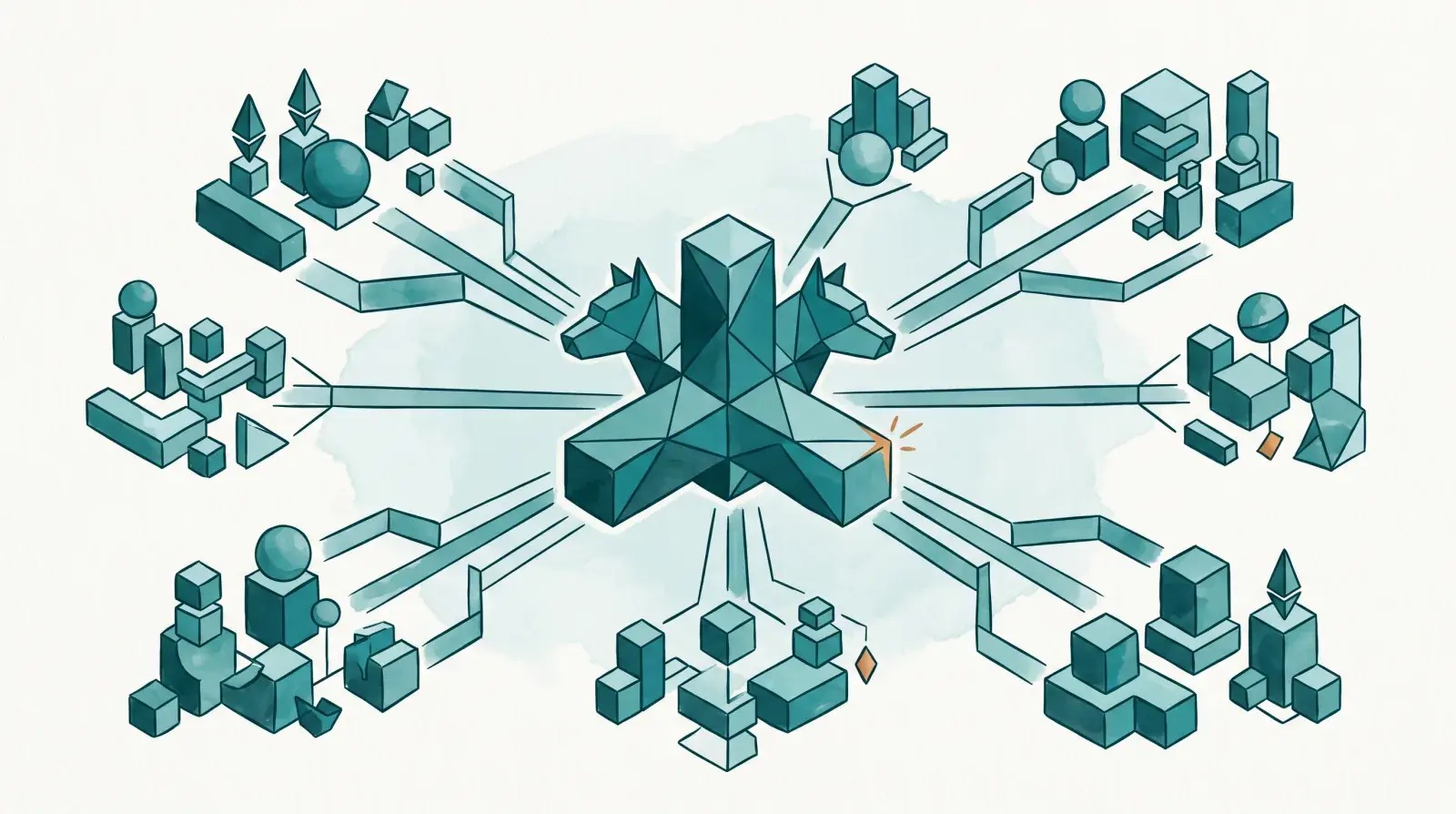
Updated: 13 August 2026. Radix is live, but the original article predates both the Olympia mainnet and the Babylon smart-contract release. Token-sale, unlocking and future-sharding sections are historical.
What is Radix in 2026?
Radix is a delegated-proof-of-stake layer-1 network designed around asset-oriented smart contracts. Its production mainnet now runs the Babylon stack, including Radix Engine, the Scrypto programming language, transaction manifests and the Radix Wallet. XRD is the native fee and staking asset.
This matters because many capabilities described as future ideas in the original article have since been replaced or refined. Olympia launched in July 2021 and is now offline; its state became the starting point for Babylon. Babylon addresses, transaction structure and application model differ substantially from Olympia and from the 2020 token-sale environment.
Live network versus the original scalability thesis
The original article describes unlimited shards and braided cross-shard Cerberus as though they defined the operating network. The live Babylon network is not the fully sharded Xi’an implementation. Radix documentation still presents Xi’an as a future milestone, while 2026 strategy moved Hyperscale research toward a community-led model.
Developers should evaluate Radix on what is deployed today: Babylon’s asset-oriented engine, Scrypto components, wallet transaction previews, delegated staking and current ecosystem applications. Lab throughput figures or planned “infinite linear scalability” are not production mainnet benchmarks.
Radix Foundation transition in 2026
The Radix Foundation announced a move toward community-led operation in January 2026 and entered maintenance mode from May. It said critical infrastructure would not be discontinued without alternatives and that the Gateway, Signaling Server and Radix Connect Relay were prepaid through the end of December 2026. A community-elected Radix Accountability Council has been working on the successor DAO structure.
This is not the same as the chain shutting down—the Babylon node repository had a release in April 2026—but it changes organizational and service-continuity risk. Users, builders and validators should follow the community transition and confirm which entity maintains each dependency after 2026.
XRD and staking now
XRD pays transaction fees and can be delegated to validators. The top 100 registered validators by stake form the active set. Stakers receive validator-specific liquid stake units; unstaking produces a claim NFT that becomes redeemable after roughly one week. Rewards depend on emissions, validator reliability and fees, and they are not a fixed APY.
Current technical documentation targets about 300 million XRD of maximum network emissions per year before performance penalties. That is more precise than the original article’s “2.5% yearly inflation” statement. A 2025 token-holder consultation supported shortening the emissions schedule and reducing potential future supply by roughly six billion XRD; users should verify enacted parameters and current supply rather than treating a consultation result as an automatic protocol change.
The ERC-20 eXRD route has changed too. The old price-unlock contract and one-to-one migration instructions are not current. Radix’s 2026 strategy says Hyperlane enabled permissionless eXRD-to-XRD conversion after Instabridge shut down. Always use a current official route and verify the resource or contract address.
Original Radix article (historical archive)
The sections below preserve the project’s early architecture, token sale and roadmap. They should not be used to claim old eXRD allocations, follow obsolete unlock links or configure a present-day Radix wallet.
Radix DLT is a layer 1 distributed system to power the needs of the decentralised finance (DeFi) ecosystem. As DeFi continued to gain traction, the top blockchain networks supporting the market were already overstretched. As it turns out, scalability appears to be a hard nut to crack and hence projects like Radix DLT are formed.
The motivation behind the Radix protocol’s creation is to save the $71 billion lost every year caused by unnecessary friction in the conventional financial system and allow those at the lower and higher levels of finance to make ground by powering a strong DeFi ecosystem.
Check out our video which explains the scaling problems currently faced by Ethereum, and how Radix attempts to solve it.
Background
The Radix team believes that using distributed ledger technology (DLT) to build a permissionless network will ease the development and accessibility of innovative financial applications. With these applications, we could finally bring down the guarded walls of traditional financial markets.

The project was founded by Dan Hughes, who also happens to be its CTO. Hughes’s former work includes the design of T-Mobile’s first mobile internet platform.
Other team members include the organization’s CEO, Piers Ridyard, as well as CPO, Albert Castellana. The project is being supported by the Radix Foundation.
What is Radix DLT?
The team behind Radix DLT defines the project as the “first layer 1 protocol specifically built to serve DeFi.” The protocol seeks to remove the inefficiencies found in open finance (OpFi) both in the current and future settings. Hughes and his team want to achieve this through:
- Re-engineering the consensus mechanism used in popular blockchain systems.
- Employing decentralized virtual machines.
- Activating on-ledger code.
- Building DeFi-bound components and applications.
- Incentivizing developers who drive the growth of the new-found financial breakthrough.
Having its developers at the core of driving growth for innovative financial products, Radix provides its support by building highly-secure smart contracts, fast and interoperable OpFi decentralized applications (dApps), engaging and rewarding a distributed developer community, and guarding DeFi composability when scaling dApps on public blockchains.
Radix network
The network is made up of Cerberus (a consensus mechanism), Radix Engine (a development environment), Radix Component Catalog, and developer royalties.
Cerberus
At the heart of the protocol is Cerberus, a re-engineered consensus mechanism which uses a sharded Byzantine fault-tolerant (BFT) solution. This approach enables the system to be parallelized across multiple nodes without losing message complexity and responsiveness.
The sharding concepts allows unlimited network splits or shards. Each shard can represent anything on the platform. By allowing unlimited shards, Cerberus shifts focus from global ordering to partial ordering.
With global ordering, transactions are stored in a predefined chronological order. Partial ordering, at a very basic level, is the opposite of agreed chronological ordering. However, partial ordering has to differentiate between related and unrelated events or transactions when recording them on the blockchain.
Using a “braiding” mechanism, Cerberus uses a new BFT-style system to sign interactions between nodes handling different shards before committing transactions.
Radix Engine
This is Radix’s specialized application layer that powers the interaction between a smart contract’s code with the actual blockchain. The layer powers the project’s virtual machine (VM), which in turn, powers the partial ordering system.
Furthermore, the Radix VM handles concurrency to drive DeFi applications further.
Radix Component Catalog
In other blockchain systems, a developer’s work becomes an active smart contract after being pushed to the system’s users. For Radix, the component catalog handles apps before being registered as “active” on the platform.

In other words, the catalog contains templates ready for use to create additional active components. The new template-based products are called instantiated components.
Developer Royalties
The Radix system uses developer royalties to encourage developers to contribute. However, the project takes a different approach by employing distributed self-incentives such as those found in proof-of-work systems called mining rewards.
Radix Token ($XRD)
The platform has a native token, XRD, which is used to pay for transaction fees. Note that these fees are paid to node runners.
A transaction fee is charged for token creation, messaging, and anything else that requires a change of the ledger state. The fee is burnt upon validation of the operation.
Furthermore, the platform’s tokens have a controlled unlocking mechanism that spans 365 days. With each unlocking, the Radix Foundation’s amount of XRD reduces while those in the public domain increases.
E-Radix (eXRD) Token Sale and tokenomics
Radix Token Sale began on 8th October 2020 and a total of 642mil E-RADIX tokens were available to purchase at $0.039 per token.
There will be an Initial Supply of 4.41 billion E-RADIX as both locked and unlocked tokens. The following chart shows the proposed distribution of the Initial Supply tokens.

The unlocking mechanism for E-RADIX tokens will start on 17th November 2020. Of the Initial Supply of 4.41 billion E-RADIX tokens, 4.2 Billion tokens will be distributed and of which 99% will be locked and 1% unlocked.
These locked tokens are subject to a price-based unlocking schedule which will allow holders to withdraw the tokens at certain price milestones as follows:

E-RADIX will be available for trading on Uniswap.
This E-RADIX token is an ERC-20 token. When the RADIX ledger is instantiated, this E-RADIX token will be exchangeable 1:1 for RADIX (XRD) tokens. As mentioned in their key milestones article, the Team are on track for the Radix main net to go live in Q2 2021.
On the mainnet, Radix will create a further 5.19 billion RADIX tokens which will also follow the same unlocking schedule as the E-RADIX tokens mentioned above.
How to withdraw your unlocked E-RADIX (eXRD) and RADIX (XRD) tokens
As mentioned in the previous section, E-RADIX and RADIX tokens are subject to a price-based unlocking schedule. However, to claim these tokens you will need to withdraw them from the unlocking smart contract.
This involves visiting their Radix tokens unlocking website and connecting the wallet that you used to purchase the E-RADIX tokens. If that wallet address has an allocation of EXRD in the unlocking smart contract, you will see details of your total allocation together with the amount which is unlocked and can be withdrawn. Then all that is required is to click the “withdraw” button and follow the steps to withdraw the eXRD.
Make sure to check back when an unlocking event occurs because it will mean you can withdraw more tokens!
For a detailed walkthrough on how to claim your unlocked tokens, click here.
Staking Radix Token
With OpFi, staking, yield farming, and liquidity mining are common occurrences. Radix powers this DeFi subset by allowing users to lock their XRD to earn network emissions and be involved in decision making.
Network emissions are periodically generated tokens that are spread across active staking nodes while considering the amount of staked tokens. Emissions make up for 2.5% of the yearly inflation rate.
There are two approaches to locking tokens:
- A user can lock XRD and become a node runner on the network; or
- a user can lock Radix tokens and delegate his stake to another node runner, also called a staking node. A staking node has the power to validate transactions.
Radix’s consensus mechanism limits the stake weight per node to 33% to prevent node runners from having absolute power over the transaction validation process.
Network Subsidy
The network subsidy is an additional amount of tokens distributed to transaction validators. The tokens are unlocked by the Radix Foundation every 24 hours and are expected to run for 10 years. However, to earn the subsidy tokens, a staking node has to consistently meet specific factors on responsiveness, bandwidth, and computing power.
Other Radix token categories are the public token grant to support community contributors, the Radix team token grant to support the team, and the stable token reserve that supports stable coins on the network.
Conclusion
The projected growth of the DeFi market requires creating new distributed systems that, if possible, have unlimited scalability. Radix is one such project. With a key focus in leading the migration from centralized finance (CeFi), the project provides hope to the future of OpFi.
From a re-designed consensus mechanism to decentralized self-incentives for developers, the project is keen on ensuring that DeFi overshadows CeFi.
The Radix token supply approach is another key component of the network that shifts from the traditional approach of major blockchain-based systems that power OpFi protocols.
Radix and XRD FAQ
What is Radix DLT?
Radix is a delegated-proof-of-stake layer-1 network built for asset-oriented applications. Its Babylon mainnet uses Radix Engine, Scrypto components, transaction manifests and the Radix Wallet.
Is Radix still active in 2026?
Yes. Babylon remains the production network and the node repository published a release in April 2026. However, the Radix Foundation entered maintenance mode while responsibilities transition toward community-led organizations.
What is Babylon on Radix?
Babylon is the current smart-contract generation of the Radix Public Network. It replaced Olympia and introduced the current asset-oriented engine, Scrypto application model, transaction manifests and new address formats.
Does Radix already have unlimited sharded scalability?
No. The live Babylon network should not be confused with the proposed fully sharded Xi'an milestone. Hyperscale tests and future architecture claims are not production mainnet throughput guarantees.
What is XRD used for?
XRD is the native Radix resource used to pay transaction fees and delegate stake to validators that secure consensus.
How does XRD staking work?
Users delegate XRD to a validator and receive validator-specific liquid stake units. Rewards accrue through the validator's stake pool and depend on emissions, reliability and the validator fee.
How long does it take to unstake XRD?
Unstaking returns a claim NFT that becomes redeemable for XRD after a protocol-defined delay roughly equivalent to one week. The exact claim epoch is recorded in the NFT.
How many validators secure Radix?
The top 100 registered validators by delegated stake form the active validator set for each epoch. A node outside that set does not participate in consensus or earn active-set emissions.
Can eXRD still be converted to XRD?
The old token-sale unlock and Instabridge flows are obsolete. Radix's 2026 strategy identifies Hyperlane as the permissionless eXRD-to-XRD route, but users should verify the current official interface and contracts before converting.
What are the main Radix risks?
Risks include XRD volatility, validator underperformance, smart-contract and bridge failures, limited ecosystem liquidity, future protocol changes and uncertainty during the Foundation-to-community service transition.
Radix update sources
- Radix mainnet environments — production network, identifiers and endpoints
- Native XRD documentation — fees and staking role
- Radix validator documentation — active set, stake units and unstaking
- Consensus Manager documentation — current emission mechanics
- Radix 2026 strategy — community transition and eXRD route
- Foundation maintenance-mode update — service funding and operational transition
- Babylon node repository — current software and releases
Decentralised Finance (DeFi) series: tutorials, guides and more
With content for both beginners and more advanced users, check out our YouTube DeFi series containing tutorials on the ESSENTIAL TOOLS you need for trading in the DeFi space e.g. MetaMask and Uniswap. As well as a deep dive into popular DeFi topics such as decentralized exchanges, borrowing-lending platforms and NFT marketplaces
The DeFi series on this website also covers topics not explored on YouTube. For an introduction on what is DeFi, check out Decentralized Finance (DeFi) Overview: A guide to the HOTTEST trend in cryptocurrency
Tutorials and guides for the ESSENTIAL DEFI TOOLS:
- MetaMask Guide: How to set up an account? PLUS tips and hacks for advanced users
- Uniswap review and tutorial: Beginners guide and advanced tips and tricks
- Serum DEX guide and review
- SushiSwap ($SUSHI) explained
- 1inch Exchange, Mooniswap and Chi GasToken: The ultimate review and guide
More videos and articles are coming soon as part of our DeFi series, so be sure to SUBSCRIBE to our Youtube channel so you can be notified as soon as they come out!
Disclaimer: Cryptocurrency trading involves significant risks and may result in the loss of your capital. You should carefully consider whether trading cryptocurrencies is right for you in light of your financial condition and ability to bear financial risks. Cryptocurrency prices are highly volatile and can fluctuate widely in a short period of time. As such, trading cryptocurrencies may not be suitable for everyone. Additionally, storing cryptocurrencies on a centralized exchange carries inherent risks, including the potential for loss due to hacking, exchange collapse, or other security breaches. We strongly advise that you seek independent professional advice before engaging in any cryptocurrency trading activities and carefully consider the security measures in place when choosing or storing your cryptocurrencies on a cryptocurrency exchange.
Share
Found this useful?
Share it with someone who'd want to read it.
Related
Stacks ($STX): Bringing Bitcoin’s security to decentralised apps
Stacks ($STX) (formerly Blockstack) is an open-source network that allows developers to easily build decentralised applications (such as…

Stellar Lumens (XLM) in a Nutshell
Stellar is a platform that connects banks, payments systems, and people.

Polygon ($MATIC): can it solve Ethereum’s scaling challenges?
Ethereum remains the backbone of decentralized finance, but even after its shift to proof-of-stake, scalability issues persist.